
Brand and design system
Who Hey Albert is, how he sounds and how he looks — in one place, for people and for machines.
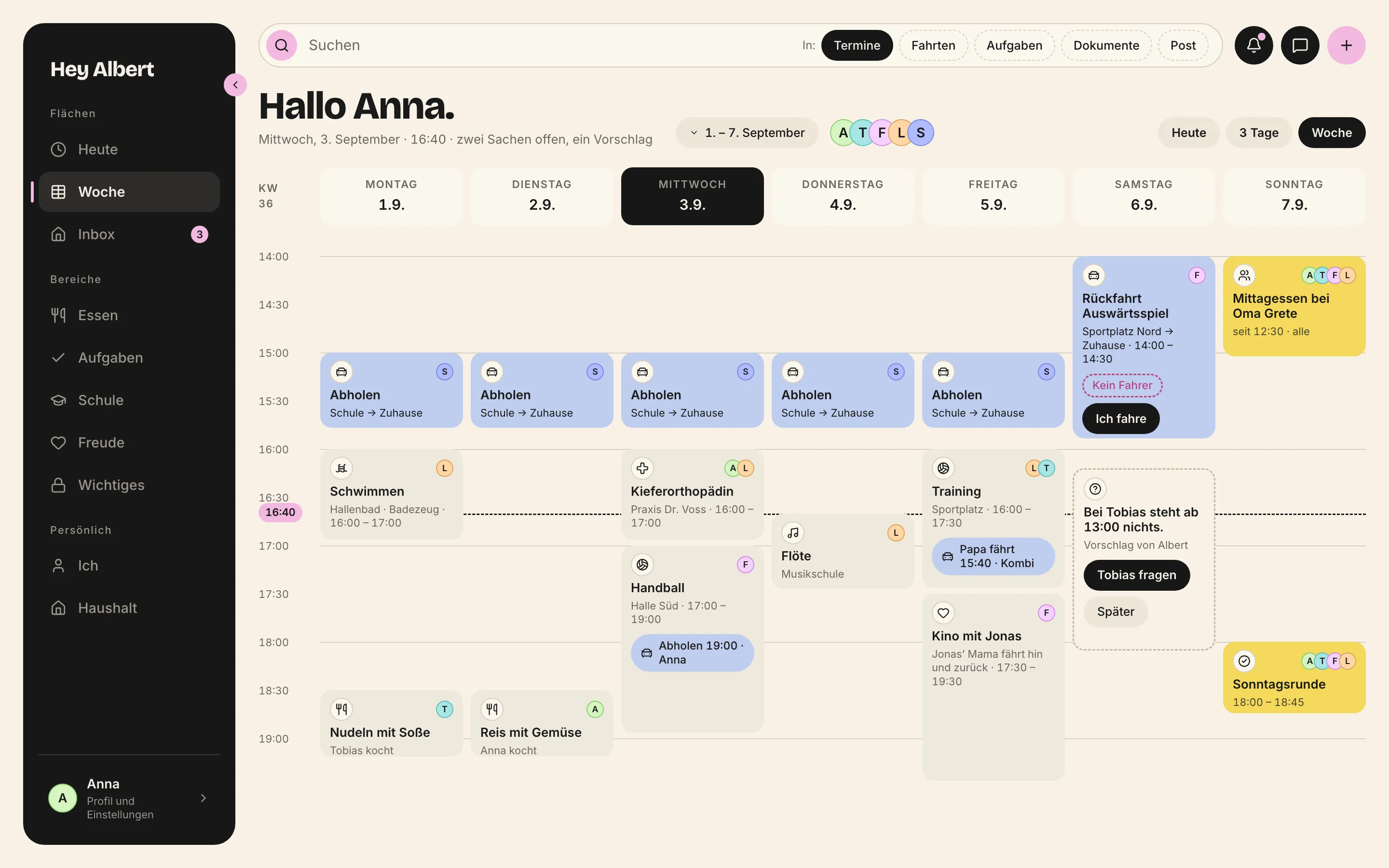
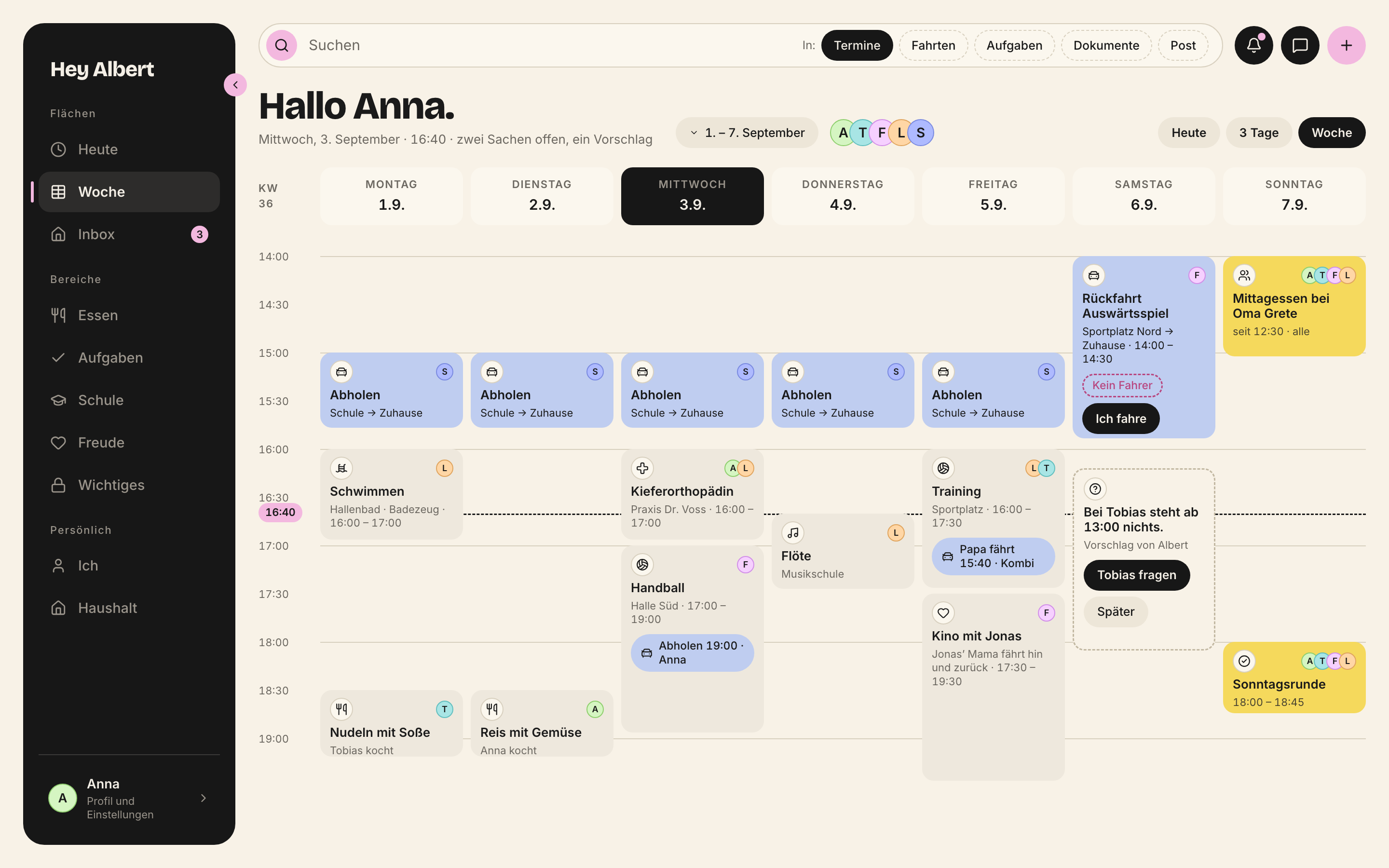
Hey Albert is the family manager for iPhone, iPad, Mac, Apple Watch and the browser. Appointments, drives, meals, school, paperwork and occasions live in one place. Every task has a name next to it. Albert suggests, a person decides.
This site shows how that sounds and how it looks. It is the one source for everyone who works on Hey Albert.
Who this site is for
The team. If you build a screen, write a sentence or design a post, you will find the rule and an example here.
Outside experts and agencies. You get the complete brand without access to the repository. Every colour, typeface and screen can be downloaded.
Language models and agents. Every chapter is also available as Markdown. Tokens, rules and components are published as JSON. An agent reads the same rules as a person.
How to use it
- Read the chapters. Eight groups on the left, from the brand to the downloads. Each chapter ends with a link to the next.
- Open as Markdown. Top right, „As Markdown“. Every page also exists at the same address with
.md, for example/en/farbe.md. - Connect machines.
/llms.txtis the index for language models. Everything else is in the chapter for machines. - Download. Logos, icons, fonts, tokens and screens, one by one or as a package.
- Light or dark. The circle at the top right switches the mode. Every colour on this site switches with it, just as in the app.
Chapter addresses and token and component names stay German on purpose — they are the names the code uses.
Five principles
They apply to every screen and every device. They are not up for negotiation.
- 1Everything has exactly one person responsible. Anything without one is a problem and is shown loudly. The only exception: the task inbox.
- 2One data model, many views. Web, Mac, iPhone, iPad and Watch show the same rows.
- 3Bundles, not loose parts. A drive brings its car, driver, passengers and checklist along.
- 4Every person has their own space. Children design theirs themselves, within contrast guardrails.
- 5Children take part; they are not an audience. Test question: could a nine-year-old use this alone?